

Instagram filter used: Normal
Photo taken at: Logan Airport – Terminal B – Boston


Instagram filter used: Normal
Photo taken at: Logan Airport – Terminal B – Boston


I’ve loved photography since I was very, very young. Going way back to my first camera, an old Kodachrome 110 to a 126 and an old 60’s model Yashica TL-Electro X 35mm. Later on I found myself shooting Polaroid because instamatics were just fun and satisfied a need for instant gratification that wasn’t repeated until today’s digital age where photos can be uploaded or shared at the touch of a button. I’ve dabbled with medium format, pinhole and other 35mm bodies like the Minolta X-700 and Canon AE-1.
Of all those, I only held onto the Yashica and the Minolta. Eventually I found myself exploring with digital going back to an early Canon Point-and-Shoot that shot 640×480 maximum and required an ungainly cable and horrific software to even get the picture off. I’ve bought and tossed many small digitals over the years, cameras I’d bought for one reason or another. Oddly, I’ve only owned one digital SLR, a Canon 350D that I’ve loved carrying around the world, taking pictures of my adventures in places like Taipei, Tokyo, London, Oxford, Prague, Switzerland and around the USA.
But I must admit I started to grow a bit tired of it all. I found myself more often than not leaving my Canon at home and just shooting things with an iPhone. The iPhone is not a good camera. Well, it’s not bad, but it’s not great. What is IS, however, is convenient. It’s small, light weight, has a reasonably decent sensor that even if it’s not the best out there, is workable. What it lacks though, is physical zoom, low-light ability and anything remotely satisfying as a photographer who likes landscapes and architectural shots and panoramics and such. It IS good for street photography, as evidenced by the literally millions of photos of every day life uploaded to the word on a daily basis.
But because of it’s limitations, I found myself again looking for something better. Something more professional. More capable. But not big and bulky. I wanted a compact camera with the benefits of an SLR without the weight, yet still capable of using those big, heavy lenses if I wanted. I really, truly, would love to have a full frame SLR one day, but the size of the things is off-putting as I don’t make a living taking pictures and the cost is astronomical in many cases.
So that set me down the path of looking at Micro 4/3’s and APS-C mirrorless cameras. They’re small, light but use interchangeable lenses allowing room to grow as well as the ability to shoot in any situation. They are basically baby SLRs, only no flappy mirror, no giant body, no big battery grip (unless you want one). They still accept hotshoe attachments (mostly flashes, video light panels and microphones) and can be used for everything from portraiture and street photography to landscapes and sports or action.
After a lot of research, reading and agonizing over details, I settled on the current Sony Alpha 6000, right now the almost top of the line mirrorless from Sony. The next level up is the A7 II, a full frame (!!) mirrorless less than the size of any full frame dSLR and just as capable. The a6000 is an amazing little camera. It’s capable of HD video at 60 fps with amazing tracking AF and lenses with power zoom for smooth transitions from close in to wide. But I don’t shoot a lot of video at all, and on the rare occasion I do, it’s with a GoPro. My interest is in the fact that it’s as capable as any prosumer SLR but half the weight and bulk.
The 16-50mm kit lens is underrated in my opinion. Of course it’s not perfect, it IS, after all, an inexpensive kit lens, but just search around a site like Flickr for photos taken with the lens and you’d be amazed at what it’s actually capable of. If that’s still not good enough, there are some very well reviewed Zeiss lenses out there that will set you back more than $1K and some in-betweeners as well like the Sony 18-105mm f3.5-5.6. There are also some very nice primes that get as fast as f2.8 or perhaps f2.
It has a good 24MP APS-C sensor, 129 AF points, great color and contrast, and a basket full of other features. One thing the Sony E-Mount cameras don’t have, yet, is a very large lens selection. That’s slowly changing, but there still aren’t as many as you’d find from Canon or Fuji or other companies out there. That’s where the adapter comes in.
I could have done this with my dSLR, and to be honest it never really clicked in my mind how much fun it could be, but for 14.00 I picked up a rather well built adapter that allows me to attach my old Minolta MD mount lenses to the 6000’s E-Mount frame. And for the first time, I have actually been giddy, even if I was just taking pictures of junk around my house. The old 50mm f/1.7 is simply astounding on this camera. My somewhat cheap Quantaray 35-200mm Macro was surprisingly good, perhaps better than I remember it being.
These are things I will still need to practice a lot with, to get back into the habit of using a purely manual focus lens without any of the benefits of modern lenses, but it’s an adventure I’m looking forward to. It’s small enough, even if I carry the heavier older Minolta glass that I can carry it around the globe and not feel like I’m lugging a suitcase just for camera gear and electronics. It’s a far better performer than my 350D and so far I’ve quite enjoyed shooting with it. I still have my old Canon 350D, but to be honest, the more I shoot with this little Sony, the less and less I feel the desire for a 5D or 1D or larger body.

I recently picked up a new set of Bluetooth earbuds for listening to music while at the gym or riding my bike or jogging. I needed the new set to replace a set of Plantronics BackBeat Go II earbuds that had died (The battery was no longer taking a charge). Because I had a warranty claim in with Plantronics on my Go II’s already, I bought the cheapest thing I could find on Amazon with fair reviews. What I ended up with was the MPow Bluetooth 4.0 Stereo Headset:
http://www.amazon.com/gp/product/B00NZTHGN2/ref=oh_aui_detailpage_o00_s00?ie=UTF8&psc=1
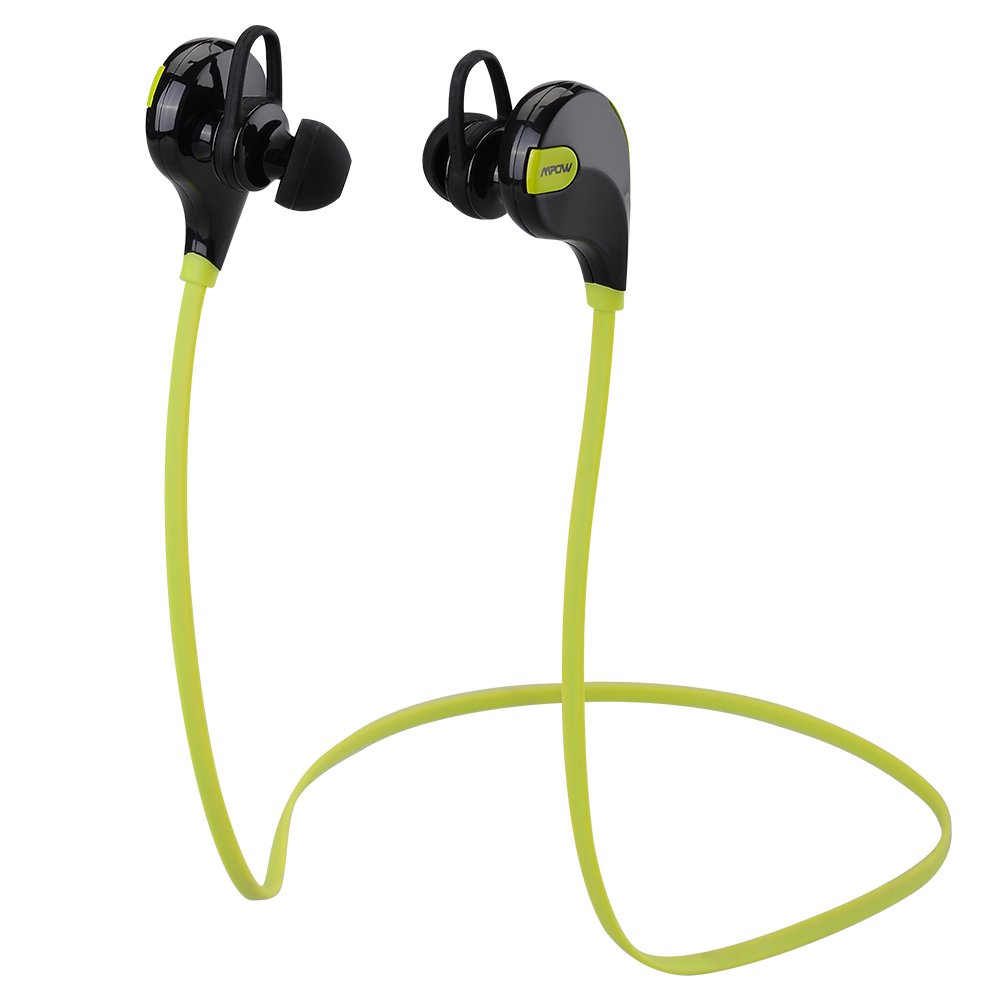
MPow Bluetooth Earbuds
I will admit, I bought these with only two expectations in mind:
1: They will pair with my iPhone so I can listen to music while working out
2: I will be able to hear music, even if it is tinny, or too low, or scratchy, or poppy, or generally low-fidelity.
I will preface this with the fact that I have not, nor do I plan to, use the phone features of this headset for making calls. I bought this specifically to replace a broken pair of Plantronics BackBeat Go II bluetooth buds for working out in the gym, jogging, or whatever. So this review only focuses o that use case.
As the title said, I was quite surprised by these. After using the medium sized hook inserts and putting the smaller ear tips on, they fit far more comfortably than I expected them to. In fact, I could conceivably wear these for hours without issue, they are as comfortable as my Bose QC-20i and Shure SE215s. They also do an admirable job of blocking noise (non-actively). I don’t hear a lot of rubbing noises as I move, they fit and sit firmly in my ears.
The sound reproduction was amazing. At least, amazing in the sense of “HOLY CRAP I DIDN’T EXPECT THAT”. The sound reproduction actually is quite good. They aren’t as good as my Shures or Bose, or other high end headsets, but you really don’t expect that from something at this price point. What you do get, however, is good, clear audio reproduction. My only real complaint there is that the sound is a bit bassy but not distorted. Just bassy with a bit of loss on the upper range. Mid-range is satisfying.
They battery life seems to be good. I really don’t know yet how long the battery will last, I’ve only used them on two gym trips so far, about and hour and 15 minutes each trip, so far on the same charge. This is already worlds above the Plantronics set that I paid twice as much for, which only have battery life for about 2 hours max.
So there are the big pros for this set of bluetooth earbuds. They are comfortable, have reasonable, and actually surprisingly good audio quality, and so far exemplary battery life.
The only con I’ve come across so far is that the controls don’t seem to control everything on my iPhone. So I can use the + and – buttons with a click and hold to skip songs, but when I use them to adjust volume, they adjust the headset volume NOT the overall phone volume. This isn’t as big a deal as it seems, though I imagine that lack of control may be an issue using them to make phone calls with.
There you have it. For the price, these are far better than they have any right to be. They’re already better than the more expensive set from the very respected Plantronics line at half the cost. These have definitely turned out to be a great purchase.
UPDATE 4-3-2015:
I’ve had these things for a couple weeks now, and in the interim, Plantronics has shipped my replacement set of BackBeat Go II headphones to me. After careful consideration of the merits of each, and after thinking long and hard, I have decided that…
… the Plantronics replacements are going on Craigslist.
I am really surprised by these things. They sound good. They’re comfortable for my use, an hour or two at a time at the gym. And the battery seem to go on forever. I’m at two weeks of use now (at about 1 hour 30 minutes a pop) and they STILL are on the original charge. Even when new, the Plantronics needed to be recharged after every two workouts. So far, I’m 7 workouts in and still haven’t had these quit on me. I’m not going to recharge them either until they do finally die on me. I want to see just how long they’ll go.
So all in all, this is still one of the most surprising purchases I’ve made in a while. I really didn’t have high expectations when I bought these headphones, but they are doing everything I expected of the Plantronics set in the first place, and they’re doing those things better.


Instagram filter used: Ludwig
Photo taken at: Waraji Japanese Restaurant


Instagram filter used: Crema
Photo taken at: Waraji Japanese Restaurant


Instagram filter used: Normal
Photo taken at: Santa Monica Pier/ 3rd Street Promenade


Instagram filter used: Earlybird
Photo taken at: Roscoe’s Chicken and Waffles


Instagram filter used: Perpetua
Photo taken at: The Getty Center, West L.A.


